
When I look back and ask myself why I became a poet, I find it difficult to answer that
question. As a child I had no special interest in, or aptitude for, language. I
loved reading, but poetry was a closed book to me. The nearest I would have
come to it was when I occasionally read a lesson from the King James version of
the Bible at our Congregational church in Epping when I was growing up. I listened
to the radio and heard the Argonauts,
I'm Sorry, I'll Read That Again and Round The Home
with the irrepressible Kenneth Williams. I remember the surprise I got when I
found out later that the Anthony Inkwell I'd heard so
often on the Argonauts was the illustrious Professor A. D. Hope. Well, poetry
came to me one afternoon when I was walking home from school; I would have been
almost seventeen. And poetry has not left me alone since. That is odd because,
for one thing, my natural feeling was always for the world of theatre. Perhaps
I had an instinct for the theatre because I was in a production of one kind or
another almost every year at primary and secondary school. I took part in
Christmas pageants; at Armidale Teachers College I sang in Carmina Burana and played the Mikado and
Bernardo in West Side Story—a
theatrical element was always present. Poetry is another matter. Max Harris
once wrote to me and said that poetry had chosen me, I hadn't chosen it, and
that was what made the difference. That is a good way of putting it, because if
you were wise, you would never choose poetry as a vocation, especially in Australia
where the poetic is more likely to be recognised in scrums or at a poker
machine. But it is one of the tasks of the poet to find the poetic in each part
of life. It is the difficult thing to express the poetry of one's life and
country memorably. At any rate, my feeling for music predated that for
language, the music of Wagner, Bruckner, Mahler and Richard Strauss.

Bayreuth Festival 1977
Götterdämmerung Act 2
Manfred Jung, Gwyneth Jones, Karl Ridderbusch
The world is swinging on the back
Of this elephant memory, its sahib desire,
Where death's a friend whose treachery's expected.
Salt
My interest in Wagner came about in
the following way. My mother belonged to the World Record Club and each month
we'd get in some LPs. And one day in came a disc of Wagner preludes and
overtures conducted by Toscanini. Well, that was the fateful moment. When I was
young I was obsessed by Wagner, and Richard Strauss.
One of the first opera sets I collected was Die Frau ohne Schatten. It didn't have a libretto and I didn't have a
clue as to what was going on, but I enjoyed the music. I was a fanatical
listener to the operas 2FC presented, and to John Cargher's
Singers of Renown. I taped the
Bayreuth broadcasts that were regularly presented. I don't think it would be an
exaggeration to say that I was sometimes in a state bordering on intoxication
when listening to these broadcasts. Then maturity set in; you start to question
the nature of the work that can produce this narcotic effect. Music remains the
planet I can visit for aesthetic refreshment without any of the hard yakka
required by the Muse of poetry. The arts are not a substitute for life, but
music, for this writer at least, makes tangible the wholeness words are always
struggling to express.
Perhaps it was with my knowledge of Wagner's life and work that my first unconscious acknowledgement came: the importance of the artist's independence from the cultural milieux of their time. You are either going to succumb to prevailing aesthetic tendencies, or strike out on your own path. Following that path puts you in the wilderness, but you cannot trim your sails to suit another's disposition. I knew that many works of art from Une Saison en enfer to the Coen brothers films had been produced independently: A Temporary Grace was published on 28th August, 1991, Such Sweet Thunder on 28th April, 1994 and A Dwelling Place on 12th July, 1997. Chomsky has demonstrated the manufactured consent engendered by political hierarchies. Some contemporary culture is a cargo cult propped up by analogous cultural groups. It is part of the artist's job to challenge their authority. Art doesn't exist to serve the idiosyncratic preferences of an establishment. A poet should not participate in the fractious world of literary politics more than is absolutely necessary. They don't have to any longer if they don't want to because the Internet has created the equivalent of a free market economy in poetry, something not seen before in the entire history of literature. It is no good objecting that much questionable material has thereby been brought to light because a great deal of questionable material was published in the old days too. In Australia you have to be conscious that the failure of the 1999 republican referendum was a corollary of an equally hidebound set of cultural parameters. As the critic and curator John McDonald wrote concerning the art hierarchy in Australia: 'The art community contains a small, highly vocal minority and a large silent majority. Unfortunately, only the minority usually seems to be considered when survey exhibitions are put together, works acquired for some public collections, or reviews and articles written for most art magazines. This threatens to restrict the scope of contemporary art even further, reducing it to a very cosy club, with a strict code of nepotism and brain-numbing conformity to fashion.' [SMH 30th December, 1989, p. 42] The literary hierarchy is no different to the artistic one. Even today, the objective, in-depth poetry review that quotes substantially from the poet's work is a rarity. Poetry written in rest of the Pacific region is largely ignored. However, as much as one might deplore this situation and recognise the political dimension that invariably surrounds the distribution and dissemination of art and artistic ideas, the creation of works of art continues unimpeded by critical or institutional bias. It would be odd if it were otherwise; art and science are alike in the sense that they have a built-in Q.E.D.
In both the
nineteenth and twentieth centuries there were many poets who kept to the path
less travelled; they honourably maintained a poetic tradition in the face of
the great Australian silence. Cultural cringe had been responsible for some
servility in the past. When the Jindyworobaks put up a plausible literary
alternative the danger of self-referentiality wasn't entirely avoided. I admire
some of the earlier generation of Australian poets who worked against fearsome
difficulties and often in squalor, particularly Henry Lawson, Christopher
Brennan and John Shaw Neilson. I don't really like much of Lawson's or
Brennan's verse, but I'm moved by the sacrifices they made and the struggle
they put up on behalf of literature. The tragic figure of Francis Webb must lie
at the root of any sensitive response to the question of Australian poetic
tradition. He not only brought forth beautiful and deeply-felt lyric verse; his
life was an amazing act of dedication, an act witnessed in the schizophrenic's
hell of isolation wards and electroconvulsive shock therapy. Alec Hope, whom I
previously mentioned, was an influential voice in the post-war period; we had a
correspondence of kinds for a while. Kenneth Slessor showed how a modem
sensibility could be accommodated in an Australian context. Judith Wright and
Gwen Harwood wrote from the advantage of a freshly-felt and expressed poetic. Of course I cannot do justice to contemporary Australian
poetry whose poets spread themselves over a vast terrain.
One picture may be worth a thousand words, but all the pictures in the world, and certainly
not the one daguerreotype left of this New England poet, could begin to equal
her staggering literary estate. Her posthumous grandeur subsumes the entire
twentieth century with its intellectual and emotional weight and devastating
metaphysical satirics. Whether it be the Cantos or the Hughes/Plath poetic bell
jar, nothing could stand in the way of her greatness, a greatness earned
through a lifetime's devotion to a literary ideal. That was an unacknowledged
greatness. Only now, her greatness is reaching into the most recalcitrant
comers. New perspectives must form in the light of the edifice she left behind,
what could so easily have been confined to the bonfire. But the stitched
packets of poems survived and, after much tampering, eventually came to view
under the superb editorial wing of Thomas Johnson. The letters too, as cryptic
and enticing as the poems. And then the life became clearer to us with the
biography of Richard Sewell. But all that
was preliminary—the life, the publication. Then began the weaving of time and
destiny as the world awoke to the distances evoked in those dash-filled poems,
distances bigger than any found between California and the New York islands.
For once a passion that will last Emily – In good faith, I think we can call her Emily, as long as we realise that Emily will
always be waiting upstairs, and will not allow us to come any closer than the
lowest rung of those Hitchcockian Amherst stairs. If we attempt to climb them we are more than likely to encounter one of those
peculiarly virulent forms of psychic torture the poet celebrated and which
Camille Paglia outlined with such glee in Sexual
Personae. We have to approach the storm of psychic energy she unleashed
carefully because you cannot take on too much of Dickinson at a sitting; the
poetry is so dense with feeling and metaphoric richness. So, we stand
at the bottom of the staircase, rather warily, like Thomas Higginson, and wait
for the woman in white to address us. But there is not just dark at the top of
those stairs, though there is darkness. There is also ecstasy, sexual passion,
scorn, contempt, beauty, rejoicing, despair. That is to say, there is poetry. Remember Jim
Morrison asking for baby to 'light my fire'. He probably never had a clue that
a New England poet lit an incendiary fire in the nineteenth century that burnt
all it encountered to stumps, and all done in tulle too, not leather trousers.
But this troubadour took himself to an early grave. And now, as the
guru-searchers tramp past Baudelaire and Piaf in Père-Lachaise en route to their encounter with the poet
manqué, doubtless they have not a clue either that back home there is a finer
dust interred, a dust that speaks to the whole world with an unparalleled
intensity and depth. The
authority of a poet like Dickinson can never be garnered through the auspices
of special pleading or parochial grandstanding. A decade or two may pass in
which a reputation takes wing before it fades from view. But Dickinson shows
that even silence, apart from those butchered poems that saw the published
light of day, could not defeat the Muse of fire that did, indeed, ascend the
brightest heaven of invention. How blinkered, by comparison, is the imperative
to 'make it new', as if artists hadn't been trying to do just that. After all,
it seems somewhat arrogant for Pound to imply that he was making it new after
the work of Dickinson and Whitman, Nietzsche and Emerson. If he helped Old
Possum get his book of cats into sleeker format, very well then. A poem such as
'Hugh Selwyn Mauberley' might be of interest to
academics and other poets; it certainly could have no appeal to the general
reading public for whom a Cole Porter, a Bob Dylan or a Gil Scott Heron were
real touchstones of the contemporaneous. All this
time Emily was waiting in the wings with her rigour, her intelligence.
Mine — by the Right of the White Election!
Mine — here — in Vision — and in Veto!
Delirious Charter! Dickinson is brilliant, but it would be impossible to try and write like her.
Her work is an outstanding example of what language can do when it is put under
imaginative pressure; the lumps of coal produce diamonds whose intensity and
light outlasted a century of manifestos and poetry wars. Australians
have certainly had a lot of cultural imperialism to put up with. Don't misunderstand
me—the English poetic tradition means a very great deal to me. We did, however,
ingest a lot of English sensibility that had nothing to do with us. We are not
one with Irish politics or culture either. I understand the importance of
ancestor worship, and I want an Australian republic too. But I see the world as
one, not Irish, not American and not Australian either. Poetry is a repository
of a tradition, a trust passed on to us through centuries of thinking, feeling
and creating. Obviously it's going to take time for
poets who write in a complex and serious way about life to get through, but
that comes with the territory. A lot of contemporary culture short-changes
society—lowest common denominator produces the big bucks. You have to try and
make art equal to life, a pretty big ask, not reduce art to the status of
commercial product.
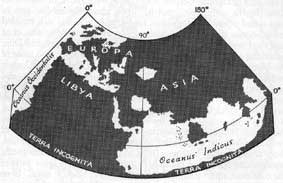
The World according to Ptolemy Beside the tournament of anchormen in London Late News A single sensibility can't soak up everything, but an Australian sensibility must at
least try to come to terms with Aboriginal culture, the heat and the light, the
oceans, droughts and bushfires. However, if a critical overview is made of
Australian culture it is no good putting northern fingers all over our sunburnt
art and thinking it is going to be a pale copy of your own culture. There has
been an enormous amount of northern drift in discussions of culture—London,
Paris, New York, St. Petersburg—while an entire hemisphere went missing.
Responses to Australian culture have often been nothing more than cliché-filled
repositories of prejudice that simply reinforce a local status quo. That is hardly an honest way of dealing with the
complexities and subtleties of a continent's artistic tradition. What can
happen is that a critic with a perceived interest or expertise is asked to
write up an article when the subject of Australia comes to hand. That can work,
but occasionally you hear the sound of an axe being ground. As Pushkin said, a
critic should be a letter bearer. Some are not content with that role, and so
they deck themselves in prophetic robes. You
sometimes hear on the radio a voice that's musical and intelligent, perceptive
and passionate. That's the way I like poetry to strike me: 'I measure every
Grief I meet', 'Le Cimetière marin', Sir Gawain and the Green Knight, 'The
Orange Tree', 'The Love Song of J. Alfred Prufrock', 'Ode To a Nightingale', 'Archaischer Torso Apollos', 'The Garden', 'Wandrers Nachtlied II',
'The Planet On The Table', 'Glory Be To God For Dappled Things', 'L 'invitation
au voyage', 'Five Bells', 'Intimations Of Immortality From Recollections Of
Early Childhood'. Earlier on I
spoke of my interest in the theatre. When I became a teacher, all that
theatrical side of me passed underground, but despite that, my poetry still
seems to have an inherently theatrical feel to it. When I was young I was a terrible stage-door Johnny, and in my time met
people as various as Margot Fonteyn, Birgit Nilsson and, on one memorable
occasion, Benjamin Britten and Peter Pears when they came out of a rehearsal of
the church parables that were being presented at the 1970 Adelaide Festival. My
mother had learnt piano at the Conservatorium with Alexander Sverjensky, and there is a picture of my mother's father
playing the violin, although I never saw him play. We had an old pianola in my
bedroom and I used to crank out the piano rolls. I wanted to play but only got
as far as Grainger's Country Gardens.
However, I was a keen attender of the Proms, the opera and the ballet. I
especially remember a fantastic production of Turandot with Morag Beaton swathed in an enormous peacock train. I
had the great pleasure of telling her just how much her performance meant to me
at a function in 1999. There were many brilliant performances—Jenufa under the
direction of Edward Downes, Robyn Nevin's
Miss Docker in Patrick White's A Cheery
Soul, Leonard Bernstein and the New York Philharmonic's performance of
Mahler's 5th. Now, as much
as I owe to music, and musical expression, I knew that poetry aspired to a
different status. The use of language in the poem, the novel, play or essay,
requires a different sensibility. To discipline the literary sensibility so
that it becomes a vehicle able to accurately express your perceptions requires
a technique as developed as Bernini's sculptural hand or Horowitz' finger work.
The subtlety of a line of Verlaine comes after a mastery of confrontations with
an enigmatic and variable emotional biography. Failures of sensibility show up
quickly in poetry because the text is left so exposed. Prose enables the horse
to bolt but keeps the rider in the saddle; poetry doesn't allow for that.
However, you're always going to come across consumers of culture who have
fallen for the hokum spun in review pages and promulgated by tunnel vision. A
decent artist acknowledges their successes and failures, even if you can
sometimes be mistaken in evaluating your earlier work. NKVD File of Osip Mandelstam Lustre The
political is an aspect of my work which is expressed both overtly, as in 'And The Winner Is . . .', and covertly. I follow no particular
political bent except that I believe in democratic values and have a dislike of
authoritarianism. I'm happy for people to express themselves in any way they
want, although personally I prefer art that shows a knowledge of, and respect
for, the cultural inheritance that has brought us to the present moment. I'd
lost my illusions about the political process fairly early on: what is
pragmatically possible is the best that we can hope for. Both idealism and
political activism are essential, but some writers get seduced by the evasions
and flattery of politics. All good writing is political in the sense that it
seeks to ask questions of life, but to mistake that political dimension for the
actual effort that puts the refugee in a warm bed at night or bandages the
wounded arm betrays a fatal misunderstanding. When Mandelstam wrote his poem
about Stalin he was carrying out a truly heroic
political act; he knew he was signing a death warrant. My first
intuition of political realities and their consequences came with the 1959 hit
song, Toni Fisher's 'West of the Wall'. I wouldn't have appreciated the
political situation the song described—'The world knows of our sadness and we
are not alone'—but I remembered the song and its lyrics. Like many Australians,
I welcomed the arrival of the Whitlam Labor
government, but was prone to some unreal Romantic mythologising. After what
seemed like the torpor of decades, Australia embraced the contemporary with a
vengeance. It was all too much for the general populace who gave the government
its marching orders after three years of spills and thrills. However, there are
still some who pine for a political Utopia that never was. Even the Kerr
sacking hadn't alerted them to the fact that the deployment of political power
was what mattered, not visionary ideals. The same power plays occurred in
literature. All that Marxism ingested after the Second World War, aided and
abetted by the theorising of Adomo and Lukacs, was
thrown out and replaced by equally suspect post-modernist finger pointing and
structuralist hectoring. What this had to do with literature was anyone's
guess, but when an actual writer got snared by politics, as Amnesty
International showed, it proved difficult to duchess political realities. I never know
when inspiration is going to come. Stravinsky said that the best ideas occurred
at the piano. In other words, craft produces art. Craft—technique—is essential,
but I'm not so sure about the implications of what he says. If you don't feel
deeply when you create it shows up in the finished product. It is one of the
virtues of good art that passion can't be faked—or bought—or funded for that
matter. I try to look at life seriously; art should be a serious criticism of
life. That doesn't mean that I don't enjoy humour—a life in poetry would be
unbearable without a well-developed sense of the absurd and an ability to laugh
at yourself. However, the more I experience life and think about its
devolutions, the more mysterious and strange a thing
it seems. In poetry, you don't answer the kinds of questions that philosophy
proposes— poetry doesn't use Aristotelian logic; you are using the irrational
logic of poetry. So many poets try to define what that poetic logic consists
of, and each explanation looks convincing. The truth must be that all these
explanations constitute the meaning of poetic logic, an ocean of Dionysian and
Apollonian imagery and technique that can produce sensibilities as divergent as
Hölderlin, Rimbaud and Blok. So, I like to think the
poetry I write is working its way towards an answer, a partial answer to the
questions poetic instinct proposes. Sometimes the questions are answered
negatively, sometimes satirically, sometimes joyfully. I hope I'm open to the
art, the science and the politics about me, and that these interests are
reflected in my work. You can never be sure whether this is the case. Entrance to Auschwitz When honouring a chosen race Final Solution
As I put it in the poem 'Poet', you are 'Praising gathered worth / And skinline's various girth.' In other words, you accept the
heterogeneous nature of existence in all its variety and, if you can, offer
praise for the fact of its existence. In Australia, and perhaps elsewhere,
there's a tendency to change channels when the program on Auschwitz comes up.
Artists can't change channels; they have to confront the meanings and detritus
that history has left. But the great renovators of the human spirit are
standing at your back too. You hear the music they have made and you try to be
worthy of their inheritance. If you've come through with that kind of openness
you have probably earned the freedom that can liberate your art from the
parameters that make it amenable to the anthology and the grant. Life must
always be an unfinished thing, like those Michelangelo sculptures of slaves. Art
gives a chance for the writer to capture in words both the misery and splendour
we see about us and to show, through the suggestive power of language. If you
are one of those people who has been succoured on nihilism and taught to
distrust yourself, your feelings and your ideas, I don't see how that kind of
sensibility can produce anything worthwhile. A poet writes on promised time.
You must follow your own star, but don't expect others to; not in the
short-term. They can't and they won't. If you do follow that star your work
then has a chance of serving time, not cliques, theories or regions. I guess
this differs from Auden's view—he said a poet's hope was to be like 'some
valley cheese, / local, but prized elsewhere', notwithstanding the fact that
his personal valley included Iceland, Ischia, New York and Oxford! By virtue of
past greatness, many a city regards itself as central, celebrating achievements
not equalled in a diminished present. The critiques originating from these
sources are sometimes to be taken with a grain of salt because it is a fact
that even some of the most intelligent and perceptive people can be mistaken
about works of art. The history of culture provides innumerable examples of
important works of art being given a drubbing by the critical establishment.
Think of Les Troyens,
Carmen or Les Fleurs du Mal, three essential works of French culture hardly
greeted with open arms, something that wouldn't happen today. Yet it would be
naive to think that this situation is ever going to change. There are always
going to be those people who think they have their finger on the pulse of
art—Benjamin, Derrida, Foucault. They are people you would always want to read,
as long as you realise that they don't have anything to do with the art you are
creating. Only recently I came across these two ex cathedra statements: on the front of a collected poems of Frost—'The truth
is that Frost was the first American who could be honestly reckoned a
master-poet by world standards' Robert Graves; on the inside sleeve of the
Faber Crow—'English poetry has found
a new hero and nobody will be able to read or write verse now without the black
shape of Crow falling across the page'. Peter
Porter. In time, you learn to deconstruct reviews and editorials of this kind,
but if you took statements like these at face value, you'd abandon art on the
spot. Genuine
culture is produced through an embrace of difference. When a country produces a
D'Anunnzio and a Montale, a Hopper and a Pollock, a
Tolstoy and a Dostoevsky, it means the culture that produced them is big enough
to sustain different aesthetic points of view. What some seem to want is a
Ceausescu-like ideological space onto which they can project strange fantasies
of dominance. That is not the way art works. Do people remember the absolutely
ruthless ideological bent that dominated classical music circles in the
nineteen fifties and sixties or the existential malaise launched forth from the
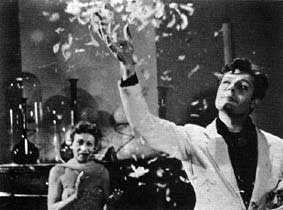
city of light, all now gone with the wind. Marcello Mastroianni in La Dolce Vita Hitch I came to cinema and art later than I should have, but at least I did come to them. As a
child I used to go to the Art Gallery of New South Wales, but the paintings on
the wall didn't mean much until later on. The Australian landscape
painters—Drysdale, Nolan, Boyd and Williams—seemed to have reached a more
realistic accommodation with the realities of Australian life than some of the
writers. And then there was the discovery of Aboriginal art which
revolutionised the way Australians looked at the country. It is one of the
ironies of our time that you often now see Aboriginal art work decorating the
foyers and boardrooms of the colonisers. The skyscrapers are hung with
disturbing reminders of a reality disguised by computer screen trading figures
and office politics. Over the years I saw a great deal of art, even though you
still had to get to the Louvre to confront Le
radeau de la Meduse.
One gallery owner in particular, Stanislas de Hautecloque
of Stadia Graphics, used to show comprehensive displays of graphic art—Goya,
Delacroix, Ensor, Kollwitz. Discovering the world of Fellini and Hitchcock, of Une Partie de Campagne, Wild
Strawberries and 2001 was a
liberation too. Who would forgo the The Simpsons or
Walking With Dinosaurs. If television can give birth to
such creations as FU in House of Cards it would be foolish to renounce
the gold that can be found elsewhere. Surely a poetic sensibility is enhanced
through contact with art of all kinds, especially the art of the newer
technologies. The world has gone global, and we now see on the screen CNN, BBC,
Reuters, satellite transmissions from anywhere and everywhere. Poetry can't
avoid the implications of this technological revolution. Many now
look to science, in preference to art, as a way of maintaining an honorable enquiry that can get beyond the failures of
history. I look at the revelations of the Hubble telescope and I'm excited by
them too. All the same, I'm wary of scientists claiming solutions to
immensities. On the Origin of Species
has changed our view of ourselves, but then so has Shakespeare. Richard Rorty
thinks it would be admirable for us 'to see Beethoven and Jefferson as animals
with extra neurons.' [TLS December 3
1999 p. 11] Snow pointed out the problems arising from viewing the world in a
way that divided up experience into either artistic or scientific
phenomena. The scientific imagination is
capable of formulating a second law of thermodynamics or of putting a
human-made object beyond our solar system. One of the chief impressions left by
many of those marvellous wildlife documentaries we see these days is that
humans and animals are basically very much alike; we are told there is only a small
amount of genetic material that makes us different from the apes. Humans are
special. The whole of the living planet is no less special, but we are unique,
and if art cannot celebrate that uniqueness, then something essential has
passed from our perception of ourselves. The beauty Blake celebrated in 'The
Tiger' was a spiritual beauty, a beauty that went beyond mere brute force. We know
the infinity in a grain of sand. Perhaps an animal can too, in its own way. But
let's not settle for believing that we are only animal in our instincts,
whatever Freud might have had to say on the matter. It was one of the greatest
failures of nerve that Western culture had seen when some started to promulgate
the idea that we were simply genetic ciphers, "hollow men" of bad
faith destined to be superseded by cyborgs, and that language was mere
automatism, a linguistic chimera. Poetry has warned of the dangers of looking
at the world through rationalist glasses. In its rhythms and energies, poetry
puts out the songlines of our humanity. Aboriginal songlines mapped an entire continent along their unmarked
fault lines. Poetry's songlines lead us to our
solitude and our joy, as well as to our sorrow. Kenneth Yasuda has written, 'The
Western mind itself, in large part, has come to devalue poetry, and indeed to
devalue its own poetry, as witness the small place it occupies in the world of
art today. Such devaluation . . . is related to the larger problem of the
validity and reality of values, the solution to which has yet to be formulated
in a way understood and accepted by Western culture at large. Where the role of
poetry is ambiguous within one's own culture, it is difficult to see how a
foreign one can be appreciated for its positive contributions.' [Yasuda The Japanese
Haiku, Charles E. Tuttle Company, 1991, p l78] Yasuda is writing about the
problems arising from Western misunderstandings of haiku, but the point is well
made. With regard
to my own poetry, it doesn't seem that my juvenilia is
indebted to any particular literary source. Some of my early inspiration came
from the New England landscape in the north of New South Wales which I got to
know well while attending Armidale Teachers College. However, I enjoy the
internationalism of city life, and my later work tends to reflect that
interest. Tradition in poetry written in English has been maintained by an
evolutionary process whose continuing development I hope I am contributing to.
I don't like analysing my work—I prize spontaneity in my writing which I hope
will not get set in the kind of literary concrete that can come about through
continual self-analysis. I want to change with time, to evolve new ways of
writing that are natural to me. And if I don't feel moved to write, I'd rather
not write anything. I admire writers who have said everything and who then shut
up shop. Capitalist
institutions have been very effective in substituting product in place of
aesthetic value. The money rolls in and gives a few incredible wealth at the
expense of the many. There is nothing wrong in itself with the Pokémon craze or
a passion for heavy metal bands, but there is a great deal wrong with cultural
product that requires conformity to stereotypes and the requirement to spend up
big to get emotional returns. Poetry has shown signs of behaving like some of
these phenomena, looking to numbers of books sold, creating cults and reducing
complexity to the standardisations we have come to expect from a certain kind
of journalism. People must find their own way through the cultural saltbush,
but it's no good if poets lose their nerve, then fold, spindle and mutilate
along the various credit lines conveniently laid out for them. Putting aside the marvellous imagery sporting
endeavours can give rise to—the grace of a Bradman stroke, the carcass of the
once-glorified Phar Lap—it seems that these sporting activities which so often
preoccupy the nation must be a substitute for a more profound encounter with
the realities of Australian existence. Australia has often given birth to
awkward customers whose complexity and drive could never fit the advertiser's
need for clichéd heroes—Chisholm, Mawson, Chifley—and Australian artists have
been no different to them. Art is meant
to dig down into this soil and put forth the images through which people may
see their own lives refracted, their own emotions portrayed, even ennobled and
transformed. Australian literature has toiled long in the vineyard of
indifference and trivialisation—many of its best practitioners have done heroic
battles with the bottle. The forbidding Australian outback seems to lie in wait
with a vengefulness that only frantic acclaim around ovals, cricket pitches and
swimming pools can assuage. Writers should confront every harsh mental and
physical interior without short-circuiting their emotional capacity and explore
the beauties and the furies they find within them. The literature brought back
from those confrontations may be ignored, but it will be something genuine and
true. Aboriginal motifs on Sydney Opera House sails Rope burn Black 1988 Most
Australians now see the Anzac tradition as an essential part of their emotional
landscape. The shocking waste of life, the political mismanagement which
brought about the carnage, the innocence with which many of the troops departed
for the great adventure overseas—all this has sunk into the Australian psyche
and given us an oceanic poetic resource in which we can find some answers for
the unyielding harshness outlined above. The fact that Gallipoli was a
monumental defeat only reinforces the power of the Anzac imagery. What followed
in its wake, the Second World War, the Vietnam war—these too reinforced the
idea of our lonely sovereignty. Sport, war,
Aboriginal history—three profound resources for the Australian writer to take
hold of. And what of the immigrant history of Australia which goes back beyond
the arrival of the First Fleet. How many despairing and joyful poetries are
waiting there to be told. The poet can do some of it, not all. It has started
to happen, and it is good to see the variety of voices now at work in
contemporary Australian literature. American
poets worked hard to stake out a specifically poetics for themselves right
through the twentieth century. Books such as Ekbert Faas' Towards A New
American Poetics set down the parameters poets like Olson, Snyder and Bly
thought were necessary to claim new expressive territory. New ways of seeing,
thinking and feeling; a radical liberation from aesthetic orthodoxy; freedom
from the supposed ideological limitations imposed by Western grammars—these
were some of the achievements claimed on behalf of modernism, its godchild,
postmodernism and the self-styled avant-garde,
both in America and elsewhere. Did these poets produce the news that was going
to stay news? We have not
wrung the neck of rhetoric, and we never will. Rhetorical utterance is an
essential part of the poetic experience. Disempowering poetry of its technical
ability to heighten language is wrong-headed. Why should anyone want to read
poetry that has no emotional depths to impart, no arresting way of expressing
itself. No-one wants to lay down prescriptive agendas anymore, but surely
poetry has to have engaged its language with social and political realities if
it is going to have relevance. It is a matter of emotional tact and verbal
subtlety as to how successfully the specific subject matter has been
confronted. You must often fail in the effort, but to write only to propitiate
the god of your own emotional ivory tower sends out the message sticks: avoid
this writer like the plague. When you are engaged, as Siegfried Sassoon clearly
was, by the hell of trench warfare, the poetry you bring back from that
experience keeps its directness; it still feels close to the dangerous edge;
its emotion are tangible. Sitwell was also capable of
memorability—'Still Falls The Rain'. You feel in that
poem that Sassoon and Sitwell have crossed the distance of two world wars and
are drawing sustenance from the same poetic source of anger and indignation. At the end,
you are left to draw on your own resources, whatever your esteem for the
grandeur we have inherited. The art of the West has been a personal
confrontation with history and aesthetics. In my poem 'Ache', I wrote, 'A
metaphysical option is delight / Of yes or no in direst circumstance.' For the
poet, the delight comes in the exercise of craft. For me, the world does give
metaphysical options; I can't see life as just due process, and I hope I
express that in my work. And yet I know that life for many people is dire,
nothing more than brute existence; slavery, abuses of the worst kind and
poverty are daily realities for millions. Doesn't your writing have to be
linked to that knowledge of how life is for the people who will never get
around to reading a book of poetry. That is why I don't preoccupy myself with
academic discourse about poetry. It isn't that I don't respect the intellectual
tradition which lies behind it; I simply cannot bring myself to believe that,
for the artist, it matters. Thus, if there is sometimes a tendency to state
rather than shape in my work, that might be put down to my dissatisfaction with
the idea, popular with some poets and those who write about poetry, that poetic
language can be experimented with indefinitely. As much as one might hanker
after the improvisatory capabilities and suggestibility of jazz or quantum
physics, the fact remains that a poet is meant to communicate with an audience.
The future
of art is unknown. There is so much waiting behind us that we have not yet come
to terms with; how can we say we are ready for the future? And yet we must be
ready for the future. We live in a period where the worth of a company such as
Microsoft has greater value than the GDP of Cuba and in which some have argued
that the Gehry Guggenheim gallery in Bilbao is a more interesting artistic
achievement than the art it houses. This is, to use the words of the Chinese
curse, living in interesting times with a vengeance. Opposition and antagonism
must be expected. A great deal of that opposition will come in the form of
intellectual disenchantment and a scepticism rooted in a distrust of human
possibilities and capabilities. For my own part, I want to move on. I'm waiting
to be surprised by the imagination and the challenges it presents. Without that
there's no progress. I mean, I look forward to that. I'm waiting for that now.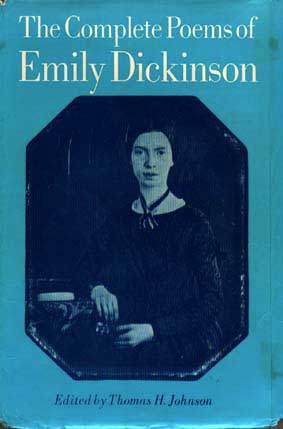
Past what rusts and buckles,
There with Walt in double grandeur,
Mystery's odd couple.
Mine — by the Royal Seal!
Mine — by the Sign in the Scarlet prison —
Bars — cannot conceal!
Mine — by the Grave's Repeal —
Titled — Confirmed —
Mine — long as Ages steal!
Or New York bravos for the Met's last show
There's splendour in the brick veneer's fierce acres
And different beauty, difficult to prove,
Because it is removed from all the baggage
Heaped at capital corners where time
Strokes itself in ego-stretching cities.

Through this there is a music
That can't be denied,
A frequency not halted,
Surpassing every stroke
That butchered in the shadow of the furnace,
A thing whose greatness bears
That magnitude which flows
Beyond our terminus,
A mind no tear has felt
Or haemorrhage yet blooded.

Beware the state's new testaments.
There's always a hitch in things
For those who think the sweet life
Can shimmer off the shadow of a doubt.

Patterns skin
Dropped in sudden graves,
Like enigmas bearing
Every failed intent
Of brief government.

Earth over the Moon
Now walk the fragrant earth,
All of living registered
On your stretching frame.
The great attractor, crackling,
Will never seek to name
Your goodness or your mystery;
They are yours alone,
And all time sits on your skin
As you peruse the sky
While everything's embraced
By what we have survived.
Great Attractor